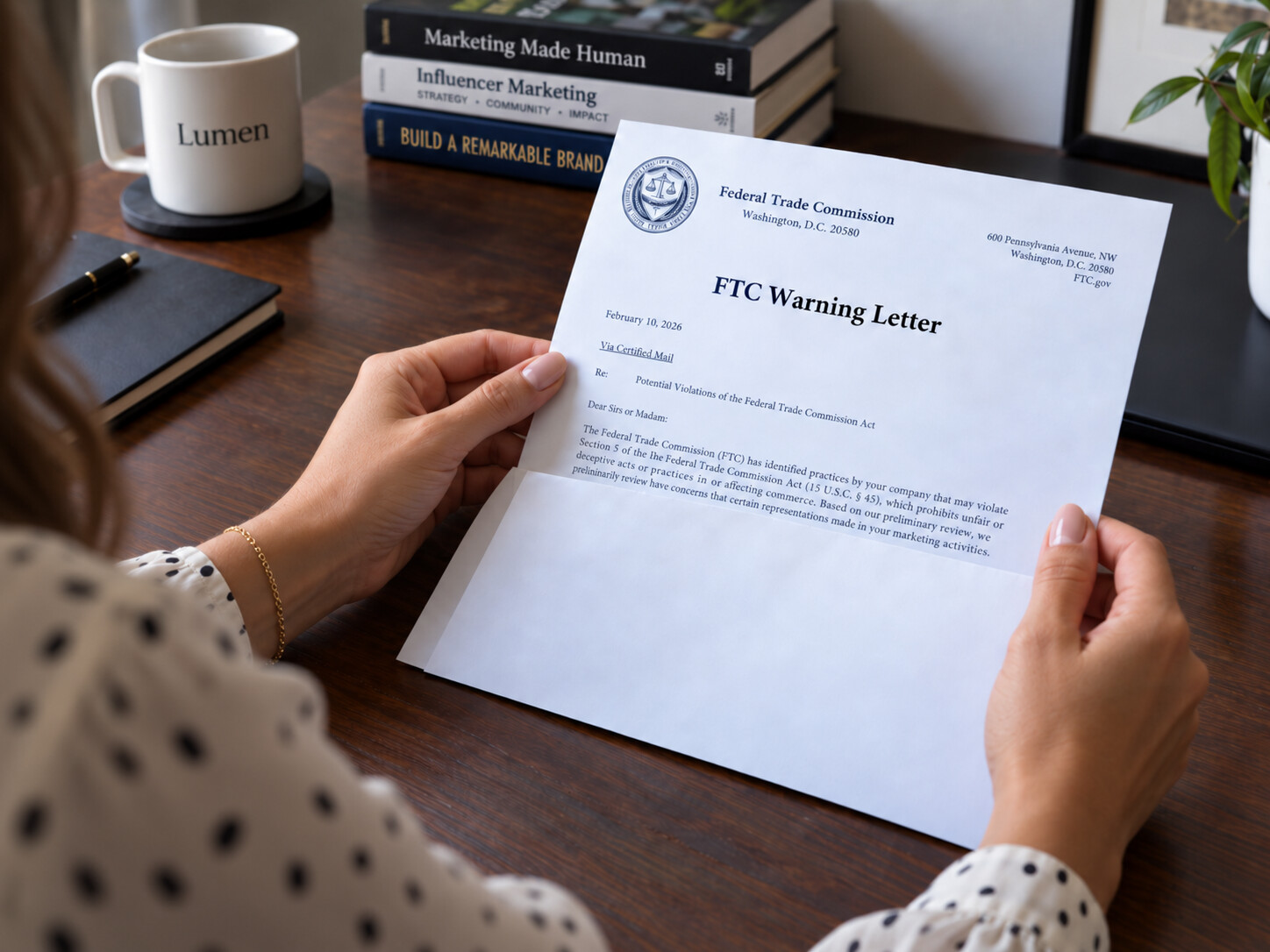
There is no split
Most brands come to this question hoping for a split: how much of the disclosure obligation sits with the brand, and how much sits with the creator. There isn’t one. The FTC’s Endorsement Guides treat a paid creator post as the brand’s own advertising, so an inadequate disclosure is a problem with your advertising. Creators can be named too, and plaintiffs increasingly name them, but that doesn’t reduce what the brand carries.
This is why “we didn’t know about that post” describes the problem rather than answers it. A program with 400 creators and no record of what went live isn’t lower risk than one with 40. It’s the same risk with less visibility.
“When it comes to influencer content, brands are held responsible, even if they never saw the post before it went live.”
Oversight, not just paperwork
Regulators, courts, and platforms tend to look for the same thing: a program that’s actively managed, not just documented. That generally means training the people you pay, giving disclosure instructions specific to the format creators are posting in, monitoring what actually publishes, and acting when something is wrong. Each of those is a verb. A signed acknowledgment shows that you asked. It doesn’t show that you were watching.
When questions come, the difference tends to surface right away. It’s rarely “did you have a policy.” It’s closer to “show us the last twelve months, and show us what you did about the posts that missed.”
- Contract clause requiring FTC compliance
- One-time onboarding deck
- Spot-checking a handful of posts
- Escalation by inbox thread
- Format-specific disclosure guidance per deliverable
- Review of record before publish where you control timing
- Continuous detection of live affiliate posts
- Dated findings, decisions, and remediations
The 2025 class actions changed the math
Until recently, disclosure exposure was priced as a regulatory tail risk: unlikely, survivable, resolved by consent order. 2025 introduced a private plaintiffs’ bar to the same fact pattern, using state consumer-protection statutes and a price-premium damages theory. How far those suits get is still unsettled, as below. The complaints are close to interchangeable: undisclosed paid posts presented as organic enthusiasm, and consumers who say they paid more than they otherwise would have.[1]
Dubreu v. Celsius
PendingCelsius and three creators named in a proposed nationwide class. Posts alleged to read as genuine opinion while paid. Background · case summary
Negreanu v. Revolve
Class claims struck$50M sought on a price-premium theory: prices alleged to run 10 to 40 percent above competitors. The complaint quotes Revolve’s own annual-report risk factor about its influencer network back at it. Complaint · arbitration order
Bengoechea v. Shein
Arbitration soughtOver $500M sought. Seven creators alleged to have presented as ordinary shoppers rather than paid ambassadors, with disclosures omitted or buried. Defendants moved to dismiss June 11, 2025; Shein has separately pressed for arbitration. Law360 coverage
Two of the three have been routed out of court, or are trying to be. On September 17, 2025, the court compelled Negreanu’s claims to individual arbitration and struck the class allegations: the checkout click accepted terms carrying an arbitration clause and a class waiver, and the court rejected both the inconspicuousness and unconscionability arguments. Shein has pressed the same route in the Northern District of Illinois. So far the private-plaintiff theory is not thriving in front of juries. It is being redirected into individual proceedings.[5]
That is a real limit on the class-damages threat. It is not a reason to relax. Arbitration changes the forum, the scale, and the publicity, not the question asked: which posts, on what dates, disclosed what. A claim you answer one at a time still requires the same record, and arbitrators reach the merits faster than courts do.
Pop v. LuliFama.com LLC (11th Cir., Aug. 1, 2025). The panel affirmed dismissal of a putative FDUTPA class action over undisclosed Instagram endorsements, but on pleading grounds. Because the claims sounded in fraud, Rule 9(b) particularity applied, and the plaintiff had not identified which posts he saw, which defendants made them, or what he bought.[2] What it is not: a holding that undisclosed endorsements are lawful. The theory survives; the pleading did not. Expect better-pleaded complaints that name specific posts and specific dates, which is exactly the evidence a monitored program has and an unmonitored one does not.
Statutory maximum civil penalty is $53,088 per violation under FTC Act §§ 5(l) and 5(m)(1) (16 C.F.R. § 1.98, in force for 2026).[3] Penalties of this kind attach where there is a prior order or a Notice of Penalty Offenses, so treat this as the outer bound of a per-post exposure, not an expected value.
NAD gets there first
The forum most likely to reach your program first is not a regulator. The National Advertising Division is a self-regulatory body that reviews national advertising claims and refers non-compliant advertisers to the FTC, and it was active through 2025 on influencer and ambassador disclosure, including a January 2025 decision recommending that Revolve modify influencer posts and rewrite the guidelines it gave its gifting-program ambassadors.[4]
Two features matter to counsel. First, cases can be brought by a competitor, which means the trigger is commercial, not statistical. You do not have to be an outlier to be challenged, only to be winning. Second, the timeline runs in weeks. A competitor challenge, an inquiry into whether a post disclosed adequately, and a request for the underlying record can all land before a regulator has opened anything.
Which is why “we could reconstruct it if we had to” is the wrong readiness posture. Reconstruction takes longer than the response window.
What a contract can and cannot do
Indemnity is worth having. It is not worth mistaking for a transfer of liability. Private allocation between a brand and a creator binds those two parties; it does not bind the Commission, a state attorney general, or a class of consumers. The letter still comes to you, and you still answer it.
- Set the disclosure standard per format, in writing
- Require pre-publish submission on paid deliverables
- Create a takedown and correction right you can exercise fast
- Recover some cost after the fact
- Evidence that instructions were given, and when
- Move FTC liability off the advertiser
- Bind consumers who never signed it
- Substitute for monitoring the brand actually performs
- Produce a record it never required anyone to keep
- Answer “what did you do when you found out”
What reasonable monitoring looks like at 400 creators
Reasonableness scales with the program. At twenty creators, a person reading every post is reasonable. At four hundred, most of them affiliate or Shop creators you never briefed and cannot gate, a person reading every post is not a control, it is an aspiration. The version enforcement history has treated more favorably tends to have four properties.
Every piece of paid content reviewed before publish; every detected affiliate post scored after. Not a sample you cannot describe the boundaries of.
If your threshold for acceptable changed in March, the record should say who changed it, from what to what, and why.
“Disclosure observed in caption; not observed in frames or transcript.” Location-specific findings survive cross-examination. Conclusions without provenance do not.
An open flag from eleven months ago is worse than no flag. Every finding needs a dated disposition: revised, taken down, accepted with reasoning, or escalated.
The documentation that survives an inquiry
Assume a request for the last twelve months. Here is what gets asked, against what most programs can actually produce on a two-week clock.
The bottom four rows are where positions are won or lost. A program that produces them is describing a control environment. A program that cannot is describing an intention.
What PinkSpider puts on the record
Three capabilities exist specifically because counsel asked for the bottom four rows.
Each submission and each detected post carries its full chain: what was scored across the five compliance dimensions, what was flagged, what was decided, by whom, and when. The history is the artifact you hand over, not a report you assemble afterwards.
When a reviewer disagrees with the model, the override is recorded alongside the original finding, not in place of it. Both remain visible, with the reviewer’s reasoning. Deleting the original finding would read as the bigger risk; keeping a documented, reasoned human judgment reads as the stronger record.
Adjust how a dimension is weighted and the platform records who changed it, from what value to what value, with notes, exportable to CSV. That closes the last row of the table above: your standard has a version history, and it can be produced.
Twelve-month content audit
We pull the public creator content already published about your brand over the last twelve months, score it across the five dimensions, and return the findings with where each was observed. It is the same twelve months an inquiry would ask about. Read it before someone else does.
Request the auditTwelve-month content audit.
Tell us the brand and we pull the public creator content published about it over the last twelve months, score every piece across the five compliance dimensions, and return the findings with where each was observed.
Sources & posture
- The 2025 filings. Dubreu v. Celsius Holdings, No. 5:25-cv-00180 (C.D. Cal., filed Jan. 22, 2025); Bengoechea v. Roadget Business PTE (Shein), No. 1:25-cv-01402 (N.D. Ill., filed Feb. 10, 2025), over $500M sought; Negreanu v. Revolve Group, No. 2:25-cv-03186 (C.D. Cal., filed Apr. 11, 2025), $50M sought. Damages are as pleaded, not court findings. Frankfurt Kurnit survey · Morgan Lewis, June 2025 · Pierce Atwood
- Pop v. LuliFama.com LLC, No. 24-11048 (11th Cir. Aug. 1, 2025), affirming dismissal of FDUTPA claims for failure to satisfy Rule 9(b). Opinion on Justia · full text (CourtListener) · Eleventh Circuit Business Blog
- Penalty ceiling. 16 C.F.R. § 1.98. The FTC’s inflation adjustment, effective Jan. 17, 2025, raised the maximum from $51,744 to $53,088 per violation under FTC Act §§ 5(l) and 5(m)(1). eCFR § 1.98 · FTC announcement · Federal Register
- NAD. NAD recommended Revolve modify influencer posts to clearly and conspicuously disclose material connections in its product gifting program (decision announced Jan. 29, 2025), a matter that originated in NAD’s own routine monitoring rather than a competitor challenge. BBB National Programs · ArentFox Schiff analysis · Olshan, decision detail
- Revolve compelled to arbitration. Order of Sept. 17, 2025 (C.D. Cal.): claims sent to individual arbitration and class allegations struck. The Fashion Law · docket documents
This guide is general information about regulatory posture, not legal advice, and cases described here are active. Confirm the current status of any matter before relying on it.
This article is provided by PinkSpider for general informational and educational purposes only, and should not be considered legal advice. Advertising requirements and platform policies may vary by industry, jurisdiction, and circumstance and are subject to change. Readers should consult qualified legal counsel when evaluating compliance requirements for their specific business or marketing activities.